en
en



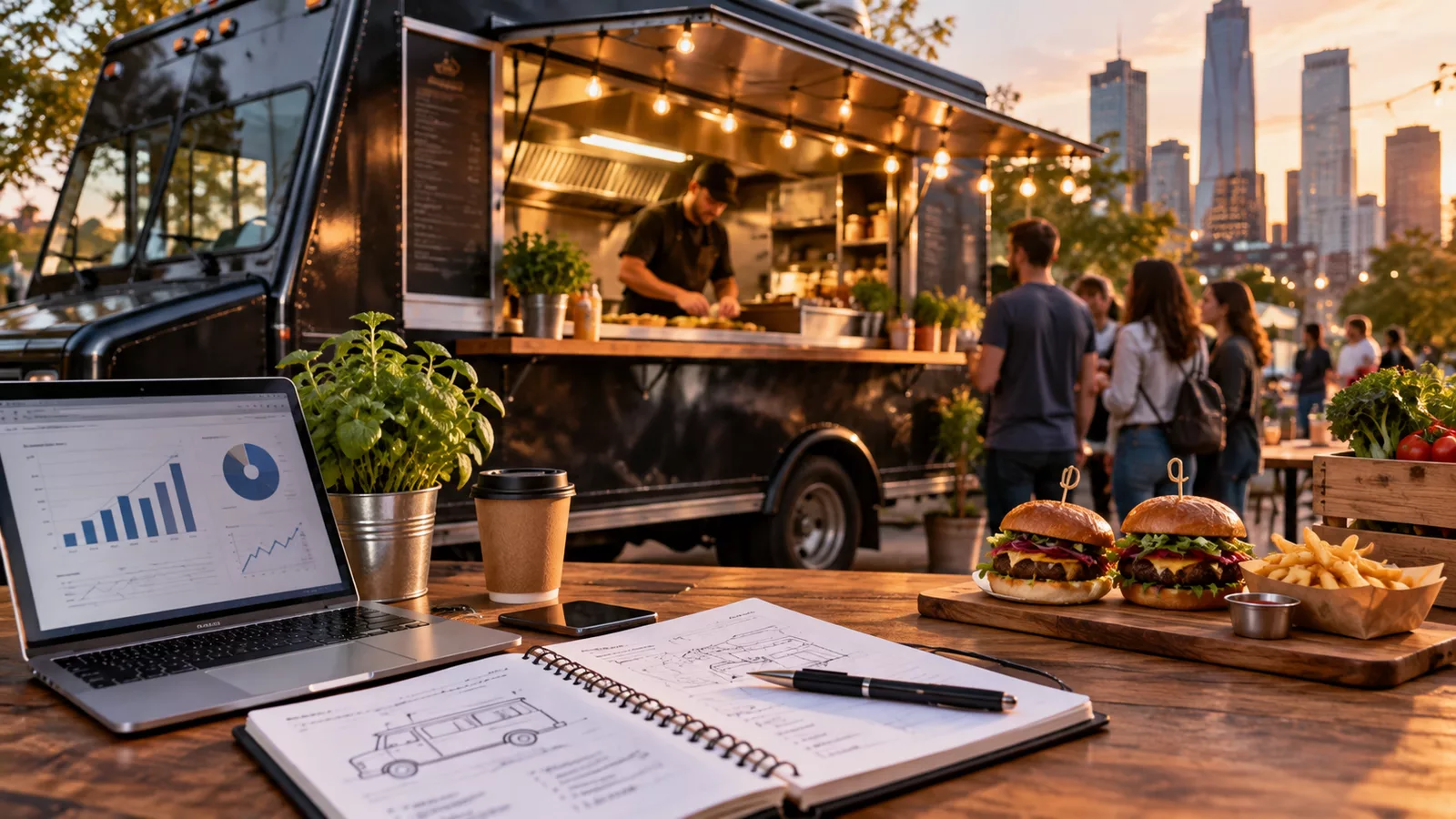
A business plan of a food truck should answer a harder question than what food will be served: can this business consistently make enough money to cover food, labor, fuel, permits, insurance, maintenance, location costs and the original investment? In 2026, that means building the plan around real operating assumptions rather than filling a generic template with optimistic revenue estimates.
A food truck can have advantages over a traditional restaurant, including mobility, a smaller footprint and the ability to test different locations. It also has constraints that a standard restaurant business plan may underestimate. Kitchen capacity is limited, the vehicle itself can become a single point of failure, weather can affect traffic, regulations vary by location, and a profitable-looking event can become far less attractive after pitch fees and labor are included.
The strongest food truck business plan therefore connects four things: what is sold, where it is sold, how many orders can physically be served and how much cash remains after every relevant cost. This guide walks through those calculations and includes a complete food truck business plan template that can be adapted to a specific concept and market.
Food Truck Business Plan at a Glance
A complete food truck business plan should cover the concept, customer, menu, locations, operations, startup costs, monthly expenses, sales assumptions, break-even point, funding and risks. These sections should work together rather than exist as separate descriptions. If the sales forecast assumes 120 orders per lunch service but the kitchen can realistically produce only 60, the financial plan is already broken.
The table below provides a practical structure before each section is developed in detail.
| Business plan section | What it needs to answer |
|---|---|
| Executive summary | What is the business and why could it work? |
| Concept | What type of food truck will operate? |
| Target customer | Who will buy and when? |
| Market analysis | Is there enough local demand? |
| Menu | What will be sold and at what margin? |
| Location strategy | Where will the truck trade? |
| Startup budget | How much capital is required before opening? |
| Operating costs | What will the business spend every month? |
| Sales forecast | How many orders can realistically be served? |
| Break-even analysis | How much must be sold to cover costs? |
| Operations | How will food, staff, prep and service work? |
| Marketing | How will customers find the truck? |
| Compliance | Which local licenses and approvals are required? |
| Funding | Where will startup and working capital come from? |
| Risk plan | What happens if sales fall or the truck stops operating? |
| Growth plan | When would a second truck or another revenue stream make sense? |
A business plan of a food truck becomes useful when every section eventually leads back to measurable assumptions. A polished concept is valuable, but the financial and operational sections determine whether that concept can survive outside a spreadsheet.
1. Define the Food Truck Concept Before Calculating Costs
The concept determines almost every number that follows. A coffee truck, burger truck, wood-fired pizza trailer and dessert van can have completely different equipment requirements, service speeds, ingredient costs and ideal locations. The business plan should therefore define exactly what the truck does before estimating how much it will cost.
Avoid broad descriptions such as “high-quality street food.” Specify the cuisine, core products, expected price range, service periods and the problem the business solves for its customer. A useful concept could be a fast lunch truck serving office districts, a late-night operation near entertainment areas, a weekend event business or a mobile catering operation built primarily around pre-booked functions.
The concept should also explain why a truck is the right format. Some menus benefit from mobility and compact preparation, while others require equipment, storage or preparation space that can make a truck inefficient. The business model should fit the vehicle – the vehicle should not be purchased first and force the business model to fit around it.
2. Identify the Customer and the Buying Occasion
A target customer is more useful when defined by buying behavior than by demographics alone. “Adults aged 25–40” does not explain when they become hungry, where they are standing or why they would choose a food truck instead of a nearby restaurant. A food truck business plan should connect customers to specific occasions.
For example, weekday office customers may value speed and predictable locations. Festival customers may tolerate higher prices but appear only on specific dates. University areas can offer repeat traffic but may have strong seasonality. Private catering can provide larger pre-booked orders, although the sales process is different from simply parking and waiting for walk-up customers.
Ask where the customer is, when demand peaks, how long the customer is willing to wait, what alternatives are nearby and what an acceptable average ticket looks like. Those answers later determine locations, opening hours, menu complexity and the number of transactions needed each day.
3. Research the Market One Location at a Time
Food truck market research should be local. National industry growth cannot prove that a particular street corner, office park or weekend market can support another vendor. The business plan of a food truck needs evidence about the places where the truck may actually operate.
Visit potential locations during the hours when service would take place. Count relevant foot traffic, identify nearby restaurants and food trucks, compare prices, observe queues and determine whether customers have convenient alternatives. For events, obtain attendance history where available, vendor fees, exclusivity conditions and information about competing food sellers.
Location research should answer practical questions before revenue is forecast:
- How Many Potential Customers Pass the Location During Service Hours?
- How Many Competing Food Options Are Available Nearby?
- What Prices Are Customers Already Paying?
- How Long Do Competitor Queues Become at Peak Times?
- Is Food Truck Parking or Trading Actually Permitted?
- Are There Location Fees, Revenue Shares or Minimum Commitments?
- Does Demand Change Significantly by Day, season or weather?
- Can the Truck Return Consistently Enough to Build Repeat Business?
The result should be a shortlist of realistic locations rather than one perfect spot. Mobility is useful only when there are several economically viable places to go.
4. Build a Menu for Margin and Speed, Not Just Taste
A food truck menu has to perform financially and operationally. Every additional ingredient can create purchasing, storage, preparation and waste requirements, while every complicated dish can slow service when the queue is longest. A successful menu therefore needs to balance customer appeal with contribution margin and throughput.
Start by costing each item. Include the ingredients actually used for one serving, packaging and any directly attributable extras. Then compare the selling price with the variable cost to understand how much each sale contributes toward labor, fuel, insurance, commissary expenses and other overhead.
A simple calculation is:
Contribution per item = Selling price – Variable cost per item
If a meal sells for $15 and its ingredients, packaging and transaction-related variable costs total $6, the contribution is $9 before fixed and semi-fixed expenses. That $9 is not net profit. It still has to help pay the costs of operating the truck.
Menu engineering also affects capacity. A $17 dish with a strong percentage margin may be less valuable during a busy lunch period if it takes eight minutes to produce, while a $13 item that can be assembled in two minutes may allow substantially more transactions. The food truck business plan should therefore model both margin per order and orders per service hour.
5. Test How Many Orders the Truck Can Actually Serve
Capacity is one of the most useful reality checks in a business plan of a food truck. Revenue forecasts often start with the amount the owner wants to earn and work backward. A stronger forecast starts with what the truck can physically produce and sell.
Run a timed test of the intended menu. Measure preparation, cooking, assembly, payment and handoff under realistic conditions. Then identify the bottleneck – the grill, fryer, oven, preparation station, payment process or staff member that determines maximum throughput.
Suppose the plan requires 100 orders during a three-hour lunch period. That means approximately 33 orders per hour, or one completed order every 1.8 minutes on average. If the kitchen and staff cannot sustain that pace, the sales forecast needs to change even if demand is available.
Never let projected revenue exceed realistic service capacity. A food truck cannot sell 150 lunches during a service window simply because the spreadsheet needs 150 sales to become profitable.
6. How Much Does It Cost to Start a Food Truck in 2026?
There is no reliable universal startup figure because the vehicle, kitchen specification and regulatory requirements vary enormously. Current published planning estimates frequently put a conventional U.S. food truck launch somewhere in the tens of thousands to well into six figures, with some current guides placing broad ranges around $50,000–$200,000. These should be treated as planning references rather than a quote for a specific business.
The correct number for a food truck business plan is built line by line from the actual market where the business will operate. A used truck that already has compatible equipment can produce very different economics from a new custom build. Likewise, a menu requiring substantial refrigeration, extraction, power and cooking equipment can cost much more to implement than a simpler beverage or cold-food concept.
| Startup expense | What to include |
|---|---|
| Truck or trailer | Purchase price, inspection and immediate repairs |
| Conversion/build-out | Plumbing, electrical, ventilation and interior work |
| Cooking equipment | Grills, fryers, ovens or other concept-specific equipment |
| Refrigeration | Refrigerators, freezers and cold storage |
| Power | Generator, batteries, shore power or other setup |
| Fire and safety equipment | Required suppression and safety systems |
| POS hardware | Terminal, printer and payment equipment |
| Permits and licenses | Local business and food-service requirements |
| Insurance | Appropriate vehicle and business coverage |
| Commissary | Deposits and initial fees where applicable |
| Branding | Wrap, signage and menu boards |
| Opening inventory | Food, beverages and packaging |
| Smallwares | Utensils, containers, cleaning equipment and tools |
| Professional costs | Accounting, legal or specialist assistance if needed |
| Launch marketing | Website, photography, advertising and promotions |
| Working capital | Cash available after the truck opens |
| Contingency | Unexpected build, repair or compliance costs |
The important figure is not simply “truck cost.” It is total cash required to reach opening day while still retaining enough money to operate afterward. Spending the entire budget on the vehicle can leave a promising business unable to survive its first slow month or major repair.
The same principle applies to other equipment-based small businesses. The WeaveMoney guide to a vending machine business plan shows why equipment should be evaluated together with operating costs and working capital rather than as an isolated purchase.
7. New vs Used Food Truck
A used food truck can reduce the purchase price, but a lower price does not automatically mean a lower total startup cost. The existing kitchen may need to be modified for a different menu, older mechanical components can require repairs, and installed equipment may not meet the requirements of the jurisdiction where the truck will operate. Inspection before purchase is therefore essential.
A new custom truck allows the kitchen layout to be designed around the menu and workflow. It can also reduce some immediate maintenance uncertainty, but the initial capital requirement is usually higher and custom construction can add lead time. The business plan should compare total investment, expected useful life, financing cost, modification requirements and downtime risk.
For either option, inspect both sides of the asset: the commercial kitchen and the vehicle carrying it. A perfect cooking line is of little use when an engine problem prevents the business from reaching its location.
8. Calculate Monthly Food Truck Operating Costs
Startup costs determine whether the business can open. Operating costs determine whether it can stay open. Both belong in the food truck business plan.
Monthly expenses can include food and beverages, packaging, wages, payroll-related costs, commissary fees, fuel, propane, electricity, insurance, parking, location fees, event fees, card-processing costs, software, cleaning, waste disposal, maintenance, marketing, bookkeeping and debt repayments. Some costs change with sales while others continue even during a weak month.
Separate costs into three groups: fixed, variable and semi-variable. This makes the break-even calculation much more useful. Food ingredients are closely connected to sales, for example, while insurance may continue regardless of whether 300 or 3,000 meals are sold.
Do not forget owner compensation. A business that appears profitable only because the owner works 60 hours a week without assigning any economic value to that labor may not be as profitable as the spreadsheet suggests.
9. Create a Food Truck Sales Forecast From Orders, Not Wishes
Revenue should be calculated from customer behavior and operating capacity. Start with expected orders per service, average ticket, number of services and additional revenue streams. Do not begin with a desired annual revenue figure and invent enough customers to reach it.
A basic formula is:
Monthly sales = Average orders per service × Average ticket × Number of services per month
Suppose a food truck completes 70 transactions per service, has an average ticket of $14 and operates 22 services in a month:
70 × $14 × 22 = $21,560 in monthly sales
That is revenue, not profit. Food costs, labor, fuel, location expenses, payment fees and other operating costs still need to be deducted.
The forecast should also distinguish revenue streams. Street service, office lunches, festivals, private catering and delivery can have different prices and costs. Combining everything into one average can hide which part of the business is actually profitable.
10. Build Three Food Truck Financial Scenarios
One forecast is not enough because real businesses rarely follow the base-case spreadsheet exactly. A business plan of a food truck should include conservative, base-case and strong-sales scenarios. This immediately shows how vulnerable the operation is to lower traffic.
Consider this simplified example.
| Scenario | Orders per service | Average ticket | Services per month | Monthly revenue |
|---|---|---|---|---|
| Conservative | 40 | $13 | 20 | $10,400 |
| Base case | 70 | $14 | 22 | $21,560 |
| Strong sales | 95 | $15 | 24 | $34,200 |
These are illustrative figures, not expected results for a typical food truck. Real assumptions should come from local prices, test events, observed traffic and the truck’s demonstrated service capacity.
The most important scenario may be the conservative one. If the business can preserve cash and continue operating when sales fall below expectations, it has more room to learn. If a 15% revenue miss immediately creates a cash crisis, the plan is fragile.
11. Calculate the Food Truck Break-Even Point
Break-even tells the operator how much must be sold before the business covers its costs. This is more actionable than simply forecasting a large annual revenue number. It can be calculated in revenue terms or in the number of orders required.
A simplified unit calculation is:
Break-even orders = Fixed operating costs ÷ Average contribution per order
Suppose fixed and semi-fixed operating costs total $9,000 per month and an average order contributes $8 after its directly variable costs. The business would need approximately:
$9,000 ÷ $8 = 1,125 orders per month
If the truck operates 22 service days, that becomes roughly:
1,125 ÷ 22 = 51 orders per service day
Now the food truck business plan has a meaningful target. Instead of saying “the truck should make $250,000 per year,” it can ask whether its locations can reliably produce at least about 51 qualifying orders per service under these assumptions.
Break-even should also be compared with capacity. If the truck needs 120 orders per service to break even but can physically produce only 80, the business model needs to change before launch.
12. Stress-Test the Business Plan of a Food Truck
A strong business plan should survive bad assumptions, not just look attractive under good ones. Stress testing changes one or more variables to see what happens to cash flow and profitability. This is particularly important for food trucks because several important variables can move simultaneously.
Test what happens if sales are 20% below the base case. Then increase ingredient costs, add an unexpected repair, reduce the number of operating days or remove a major event from the calendar. A model that remains viable under several plausible setbacks is more resilient than one that works only when every assumption is favorable.
At minimum, test these situations:
- Sales Are 20% Lower Than Forecast.
- Average Ticket Falls by 10%.
- Food Costs Increase.
- The Truck Loses Five Trading Days.
- A Major Event Is Cancelled.
- A Key Piece of Equipment Needs Repair.
- One High-Performing Location Becomes Unavailable.
- Labor Costs Increase.
- The Business Has a Slow Seasonal Month.
- A Customer Pays a Large Catering Invoice Late.
The purpose is not to predict every problem. It is to determine which problem can break the business fastest and create a reserve or response plan before it happens.
13. Protect Working Capital After Opening Day
Cash left after launch is part of the startup requirement, not spare money. A food truck may need to buy inventory before sales occur, pay deposits before events, repair equipment without warning and cover fixed expenses during bad weather. A profitable business can still fail if cash is unavailable at the wrong time.
Set a working-capital target based on actual monthly expenses and business risk rather than an arbitrary percentage of the truck purchase price. A highly seasonal business or one dependent on expensive equipment may require a larger buffer than a simple operation with predictable contracted events.
This distinction between profit and available cash matters as the business grows. WeaveMoney’s explanation of business liquidity covers why assets and accounting profit do not necessarily mean a company has enough accessible cash to meet immediate obligations.
14. Plan Locations as a Portfolio, Not a Single Parking Spot
A food truck business is mobile, so the location strategy should take advantage of that flexibility. Depending entirely on one office complex, market or event organizer creates concentration risk. A stronger plan combines several types of demand.
For example, weekday lunch stops can provide recurring sales, weekend festivals can create higher-volume opportunities, and private catering can generate pre-booked revenue. The right mix depends on the concept, but each location type should be evaluated separately because fees, labor requirements, traffic and average ticket can differ.
Create a simple location scorecard. Track revenue, transactions, average ticket, hours on site, travel time, fees, labor, waste and weather for each stop. A location with higher sales is not necessarily the better location if it also consumes substantially more time and money.
15. Include Weather and Seasonality in the Food Truck Business Plan
Weather is not merely an inconvenience for a mobile food business. It can directly affect foot traffic, event attendance, operating days and customer willingness to wait outdoors. A plan built entirely from peak-season sales can therefore exaggerate annual profitability.
Use monthly forecasts rather than dividing annual revenue evenly by 12. Consider local temperature patterns, rainy seasons, tourism cycles, university calendars, holidays, festival schedules and the operating patterns of major office districts. A summer-focused dessert concept and a hot-food truck serving office lunches may have very different seasonal curves.
Then plan a response to weak periods. Catering, corporate bookings, indoor events, delivery partnerships or reduced operating schedules can potentially diversify revenue, but each option should be evaluated on its own economics rather than treated as automatic extra income.
16. Build the Food Truck Operations Plan Around a Real Service Day
The operations section should describe what happens before, during and after service. A business plan of a food truck becomes far more useful when it explains the actual flow of ingredients, staff, equipment, customers and waste.
Map the day from purchasing and preparation through loading, travel, setup, cooking, service, payment, cleaning, waste handling, storage and closing. Identify which tasks require a commissary or other approved facility in the relevant jurisdiction. Estimate how many labor hours happen outside customer-facing service because prep and cleanup can materially change the true labor cost of each operating day.
The plan should also assign responsibility. Who buys ingredients? Who prepares food? Who drives? Who handles the POS? Who monitors inventory? Who cleans? Who responds when the generator, refrigerator or vehicle fails? A business with one owner performing every role has a different risk profile from one with trained backup staff.
17. Prepare for Vehicle and Equipment Downtime
For many food trucks, the vehicle is simultaneously transportation, kitchen and sales location. That creates concentrated operational risk. A mechanical problem can eliminate revenue even when demand, staff and ingredients are available.
Create a maintenance schedule and repair reserve from the beginning. Track the truck, generator, refrigeration, cooking equipment, fire-safety systems and other critical components. Preventive maintenance has a cost, but unexpected downtime can produce both repair expenses and lost sales.
The food truck business plan should also include a contingency. Consider whether catering can continue from another approved setup, whether a rental solution is realistically available, how customers with existing bookings would be handled and how much cash the business could absorb during a shutdown.
18. Check Permits and Food Safety Rules Before Buying the Truck
Food truck requirements are location-specific, so a generic permit checklist should never be treated as final. Depending on the jurisdiction, a business may need business registration, mobile food permits, health approvals, inspections, fire approvals, sales-tax registration, parking or vending permissions and access to an approved commissary. Requirements can also change according to the food being prepared.
The regulatory environment is especially relevant in 2026. The U.S. Food and Drug Administration released the 2026 FDA Food Code on September 17, 2026, including a new definition for “mobile food establishment.” The Food Code is a model used to support food-safety regulation rather than a single nationwide food-truck license, so operators still need to verify the rules adopted by the state and local authorities where they plan to trade.
Do this before purchasing or converting a truck. A vehicle that cannot satisfy local requirements for the intended menu can turn a seemingly inexpensive purchase into an expensive retrofit.
19. Choose a Business Structure, Insurance and Record-Keeping System
The business plan should identify how the company will be structured and administered. Registration, tax and insurance requirements depend on jurisdiction, ownership structure, employees and the way the vehicle is used. These decisions should be confirmed with the relevant authorities and qualified professionals where necessary.
Keep business money separate from personal spending from the beginning. Use a dedicated accounting process and preserve receipts, invoices, permit documents, supplier records, payroll information and sales data. Accurate records make it easier to understand food cost, location performance and actual profit instead of relying on the balance visible in a bank account.
Professional communication matters as well, particularly when approaching corporate sites, event organizers and catering customers. A dedicated domain and business email are preferable where practical, although very small operators may begin more simply. WeaveMoney also has a step-by-step guide to creating a Gmail account for business for operators setting up their initial communications.
20. Decide How the Food Truck Will Make Money
Street sales are only one possible revenue stream. Depending on the concept, the food truck business plan can evaluate regular public stops, office parks, private catering, weddings, corporate events, festivals, markets, breweries, sports events and other approved venues. The key is to calculate each channel separately.
A $3,000 private event and $3,000 of street sales are not financially identical. The private event may require a longer drive, additional staff or a customized menu, while it can also provide guaranteed revenue and a deposit in advance. Street sales may have no booking commitment but can create recurring customers.
Measure contribution after the costs associated with each channel. Over time, the business can shift toward the combination that provides the strongest return for the available labor, equipment and operating hours.
21. Create a Food Truck Marketing Plan Before Launch
Food truck marketing has an unusual challenge: customers need to know both what is being sold and where to find it. Location communication is therefore part of the product. A strong brand cannot generate lunch sales if customers do not know where the truck will be on Tuesday.
Maintain accurate opening hours and location information wherever customers are expected to look. Social channels can communicate schedule changes, new stops and limited menu items, while a simple website can provide the permanent home for menus, catering inquiries and booking information. Email or SMS can be useful for repeat customers where appropriate and permission has been obtained.
For catering, the marketing process is different. Create a clear inquiry path that collects date, location, guest count, service format and menu requirements. Fast responses and transparent booking information can matter as much as social reach.
22. Decide How the Food Truck Will Be Funded
Funding can come from owner savings, partners, loans, equipment financing or other legitimate business financing sources available in the relevant market. The right mix depends on total startup cost, cash reserves, creditworthiness and risk tolerance. Borrowing reduces the amount of owner capital required but creates repayment obligations that continue even during weak months.
Include debt service in the cash-flow forecast from the beginning. Do not calculate a profitable operating model first and then add loan payments as an afterthought. Financing changes monthly cash requirements and therefore changes break-even.
A lender-ready food truck business plan will usually need more detail than an internal plan. Financial projections, assumptions, owner contribution, funding requirement and use of funds should all be clear and internally consistent.
23. Know the Pros and Cons of Starting a Food Truck
A food truck can provide a relatively flexible way to enter food service, but flexibility does not eliminate business risk. The model works best when mobility, a focused menu and relatively compact operations create an advantage rather than simply replacing restaurant rent with vehicle and location expenses.
| Potential advantages | Potential disadvantages |
|---|---|
| Can move between demand locations | Location rules can restrict mobility |
| Smaller physical footprint than many restaurants | Kitchen and storage space are limited |
| Can test markets before permanent expansion | Weather can reduce sales |
| Suitable for events and catering | Event fees can be substantial |
| Focused menus can simplify operations | Menu capacity is constrained by equipment |
| Can build multiple revenue streams | Vehicle failure can stop operations |
| Expansion can occur through additional units | A second truck adds another complex operation |
The food truck format is neither automatically cheaper nor automatically more profitable than other food businesses. The relevant comparison is total capital, operating costs, realistic revenue and owner workload for the specific concept.
24. Avoid These 10 Food Truck Business Plan Mistakes
Many costly mistakes happen before opening day, which makes the planning stage the cheapest place to find them. A good food truck business plan should actively look for reasons the idea might fail rather than trying to prove that it will succeed.
The most important problems to test are:
- Buying The Truck Before Checking Local Requirements.
- Building Revenue Forecasts From Desired Income Instead of Orders.
- Ignoring Maximum Kitchen Capacity.
- Pricing From Competitors Instead of Actual Food Costs.
- Treating Revenue as Profit.
- Forgetting Prep, Cleanup and Administrative Labor.
- Spending All Available Cash Before Opening.
- Depending on One Location or Event Type.
- Assuming Peak-Season Sales Will Continue All Year.
- Ignoring Vehicle and Equipment Downtime.
Finding one of these weaknesses does not necessarily kill the idea. It provides an opportunity to change the menu, truck, price, location mix, funding requirement or launch strategy before the mistake becomes expensive.
25. A Practical Food Truck Business Plan Example
A short example helps show how the different sections connect. The figures below are illustrative and should not be interpreted as industry averages or expected results.
Concept: A fast-service grilled chicken wrap truck serving weekday office lunch locations and selected weekend events.
Target customer: Office workers looking for a complete lunch that can be ordered and collected quickly.
Core menu: Four wraps, two sides, drinks and one rotating special.
Average ticket assumption: $14.
Base-case volume: 70 orders per service.
Base-case schedule: 22 services per month.
Illustrative monthly revenue: $21,560 before catering or special events.
Location strategy: Three recurring weekday lunch locations plus selected weekend events.
Operations: Prep before service, two-person lunch team, simplified assembly line and limited menu during peak periods.
Main risks: Weak winter foot traffic, loss of a major lunch location, ingredient inflation, vehicle downtime and slower-than-expected service capacity.
Risk response: Maintain multiple locations, monitor menu contribution, retain working capital, schedule preventive maintenance and develop catering as a secondary revenue stream.
Expansion trigger: Consider another unit only after the first operation has demonstrated consistent positive cash flow, repeatable location economics and an operating process that does not depend entirely on the founder.
This example is intentionally simple. The real food truck business plan should replace every assumption with local evidence, supplier quotes and tested operating data as those become available.
26. Food Truck Business Plan Template
A business plan does not need unnecessary pages. It needs answers. The following template can be copied into a document and completed before committing significant capital.
Business name:
[Enter name]
Concept:
[Describe cuisine, format and customer proposition]
Target customer:
[Who buys, where and on what occasion?]
Core menu:
[List main products]
Average ticket:
[$___]
Average variable cost per order:
[$___]
Average contribution per order:
[$___]
Maximum tested orders per hour:
[___]
Target orders per service:
[___]
Primary locations:
[List locations or location types]
Services per month:
[___]
Expected monthly street sales:
[$___]
Expected monthly catering/event sales:
[$___]
Truck/trailer cost:
[$___]
Build-out and equipment:
[$___]
Permits and pre-opening costs:
[$___]
Opening inventory:
[$___]
Working capital:
[$___]
Contingency reserve:
[$___]
Total startup funding required:
[$___]
Monthly fixed and semi-fixed costs:
[$___]
Monthly break-even orders:
[___]
Break-even orders per service:
[___]
Funding source:
[Savings / loan / partner / equipment financing / other]
Commissary/prep arrangement:
[Describe]
Staffing plan:
[Describe roles and hours]
Marketing plan:
[Explain how customers will find locations and book catering]
Main risks:
[List five]
Downtime plan:
[Explain response to vehicle or equipment failure]
Conservative sales scenario:
[$___]
Base-case sales scenario:
[$___]
Strong-sales scenario:
[$___]
Expansion trigger:
[Define the conditions required before adding another truck or location]
Do not fill the template with national averages simply because local information takes longer to collect. A useful business plan becomes more accurate as assumptions are replaced with quotes, observed traffic, test-service data and actual costs.
27. The Food Truck Go/No-Go Test Before You Spend the Money
The final stage of a business plan of a food truck should be a decision test. Instead of asking whether the idea sounds exciting, ask whether the evidence supports committing capital. This is where the entire plan becomes useful.
Before buying the truck, try to answer yes to these questions:
- Is There Evidence of Demand in More Than One Viable Location?
- Has The Menu Been Costed Item by Item?
- Has Service Capacity Been Tested?
- Can The Truck Produce Enough Orders to Reach Break-Even?
- Are Local Regulatory Requirements Understood?
- Has The Intended Vehicle Been Checked Against Those Requirements?
- Does The Startup Budget Include Working Capital?
- Can The Business Survive The Conservative Sales Scenario?
- Is There Cash Available for Repairs and Downtime?
- Are Owner Labor and Debt Payments Included in the Economics?
- Is There a Plan for Seasonal or Weather-Related Sales Declines?
- Can The Business Explain Exactly What Would Trigger Expansion?
A “no” is useful information. It identifies what needs to be solved before capital is committed. The cheapest food truck problem is usually the one discovered while the truck still exists only in a spreadsheet.
Is a Food Truck Business Worth Starting in 2026?
A food truck can be a viable business in 2026 when the concept, menu, locations, capacity and costs work together. Mobility can create opportunities that a fixed restaurant does not have, but the model also introduces vehicle risk, space limitations, changing locations and weather exposure. Profitability therefore depends much more on unit economics and execution than on the popularity of food trucks in general.
The best business plan of a food truck does not promise success. It tells the operator exactly how many customers, how much contribution per order and how many operating days are required for the idea to work. It also shows what happens when those assumptions are wrong.
Build those numbers before buying the vehicle. A business plan that reveals an unworkable concept has already saved money, while a plan that survives conservative assumptions provides a much stronger foundation for the next stage.
FAQ
A food truck business plan should include an executive summary, concept, target market, menu and pricing, location strategy, startup budget, operating expenses, sales forecast, break-even analysis, operations, staffing, marketing, permits, funding, risk management and growth plan. Financial assumptions should be connected to realistic order volume and service capacity.
Costs vary widely by country, city, vehicle, menu and equipment. Current U.S.-focused planning guides commonly show broad startup ranges extending from roughly $50,000 into $200,000 or more, but a local budget should be built from actual vehicle, equipment, permit, insurance and commissary quotes rather than relying on one national average.
There is no required length for an internal food truck business plan. A concise plan with detailed financial tables can be more useful than a long document filled with generic market descriptions. Lenders or investors may require additional financial statements and supporting documentation.
A simple starting formula is average orders per service × average ticket × number of services. Separate street sales, catering, events and other revenue streams when their costs and sales patterns differ.
Estimate the contribution remaining from an average order after directly variable costs, then divide fixed and semi-fixed monthly costs by that contribution. The result estimates the number of orders required to cover those costs under the assumptions used.
There is no universal number. Required customer volume depends on average ticket, variable costs, fixed expenses and the number of operating days. Calculate the truck's own break-even orders rather than using another business's customer target.
The financial and operational assumptions are among the most important parts because they show whether the concept can work in practice. Revenue forecasts should agree with menu pricing, customer demand, service capacity and the operating schedule.
Requirements vary by jurisdiction and operation. Some authorities require or regulate the use of a commissary or approved base of operations for certain mobile food businesses, while rules differ elsewhere. Check the relevant local health and food-service authority before buying or converting a vehicle.
Requirements can include business registration, mobile food permits, health approvals, inspections, fire-related approvals, tax registrations and local vending or parking permissions. The exact combination depends on the jurisdiction, so local government and health authorities should be checked directly.
Usually, the financial model and regulatory research should come first. The menu, required equipment, local rules and expected sales determine what type of vehicle makes economic sense. Buying first can create expensive modifications later.
A food truck can be profitable, but the format itself does not guarantee profitability. Results depend on order volume, average ticket, food cost, labor, location expenses, operating efficiency, maintenance, financing and the number of viable service days.
A strong menu has clear customer demand, manageable ingredient requirements, attractive contribution per order and enough production speed for peak service. A smaller menu can sometimes improve inventory control and throughput, but the ideal size depends on the concept.
There is no universal amount. Estimate enough cash to cover realistic operating expenses, inventory needs and unexpected problems during the early months, then stress-test the amount against slower sales, repairs and lost operating days.
A detailed plan can support a financing application by explaining the concept, funding requirement, use of funds, market, operating model and financial projections. Actual lender requirements vary, and approval depends on factors beyond the business plan itself.
One of the most damaging mistakes is spending nearly all available capital on the truck and build-out while leaving too little working capital. Opening the doors is only the beginning – the business still needs cash for food, labor, fuel, insurance, fees, repairs and slow periods. budget challenge