 uk
uk



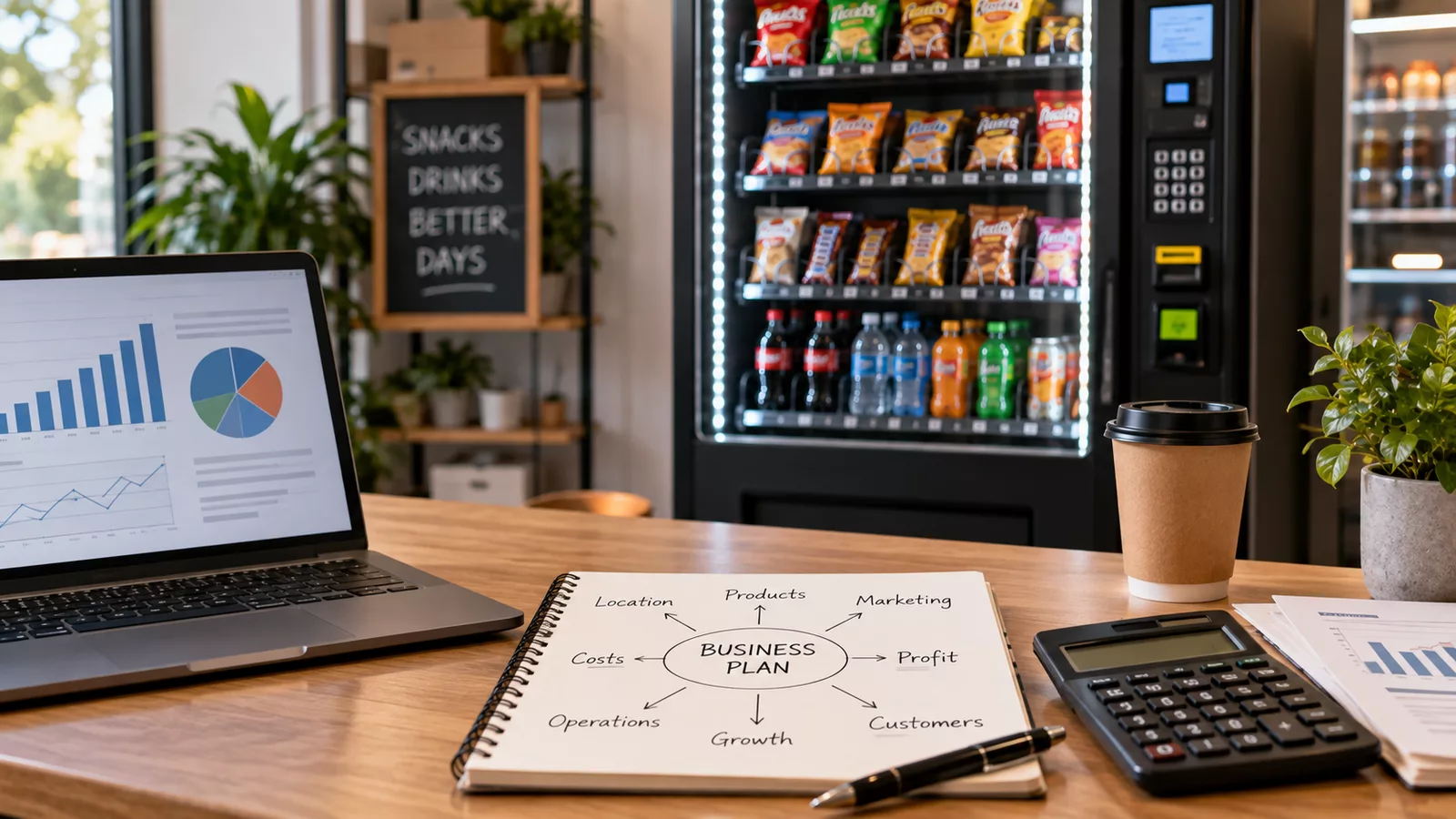
A vending machine business plan turns a seemingly simple idea – buying a machine, filling it with products and collecting sales – into a business model you can actually evaluate. It should explain where the machine will operate, who will buy from it, what it will sell, how much startup capital you need and how many monthly sales are required to make the location worthwhile.
This matters because the vending machine itself is only one part of the business. Location commissions, inventory, card-processing fees, fuel, repairs, insurance, licenses, taxes and unsold products can all reduce the money left after sales.
A useful vending machine business plan does not need to be 40 pages long. If you are starting with one or two machines, a concise plan supported by realistic calculations may be enough. The goal is to answer the questions that determine whether the business can work before significant money is committed.
Vending Machine Business Plan at a Glance
A complete plan should connect your business idea with measurable assumptions. Each part answers a different question about whether the operation can become sustainable.
| Business plan section | What it should answer |
|---|---|
| Executive summary | What are you building and why? |
| Business model | How will the vending business make money? |
| Target customer | Who is likely to use the machines? |
| Location strategy | Where will machines be placed? |
| Product strategy | What will each machine sell? |
| Startup costs | How much money is required before launch? |
| Operating costs | What will you spend every month? |
| Pricing | How much will customers pay? |
| Sales forecast | How many transactions can you realistically expect? |
| Break-even analysis | When can startup costs potentially be recovered? |
| Operations | Who restocks, cleans and repairs the machines? |
| Marketing | How will locations and customers discover the service? |
| Expansion plan | When does adding another machine make sense? |
| Risk analysis | What could cause the plan to fail? |
These sections can be expanded for investors or lenders, but even a one-machine operation benefits from answering each question.
1. Write Your Vending Machine Business Executive Summary
The executive summary is a short description of the vending machine business you intend to build. Write it after completing the rest of the plan, even though it appears first.
A basic executive summary might explain that the business will operate cashless snack-and-drink machines in office buildings, gyms or residential complexes within a defined geographic area. It should identify the initial number of machines, target customers, funding requirement and expansion objective.
Keep this section concrete. “Build a profitable vending company” says very little. “Launch three cashless snack-and-beverage machines in office locations and evaluate each machine against a minimum monthly sales target before expanding” creates a measurable strategy.
For a small operation, one or two paragraphs can be enough.
2. Choose a Vending Machine Business Model
Not every vending machine business works the same way. Your business plan should identify the model before calculating costs.
Common approaches include:
- Snack machines. Sell chips, chocolate, bars and other packaged foods.
- Beverage machines. Sell bottled or canned drinks.
- Combination machines. Offer food and beverages from one unit.
- Healthy vending. Focus on products marketed around nutrition or specific dietary preferences.
- Coffee vending. Serve coffee and other hot drinks.
- Specialty vending. Sell products such as electronics accessories, cosmetics, personal-care products or other non-food items.
- Smart vending. Use modern interfaces, telemetry, cashless payments and more sophisticated inventory monitoring.
The best model depends heavily on the location. A machine in a gym may require a different product mix from one in a warehouse, hotel or university building.
Do not buy a machine first and then search for somewhere to put it. Choose the customer and location model before choosing the hardware.
3. Define Your Target Customer
A vending machine does not need thousands of different customers. It needs enough people in the right location who regularly want what it sells.
Your vending machine business plan should therefore describe the customer at the location level.
Potential locations include:
- Office buildings. Employees may buy snacks, drinks and coffee during the working day.
- Warehouses and factories. Shift workers can create demand outside normal retail opening hours.
- Apartment buildings. Residents may value convenient access to snacks, drinks and essentials.
- Gyms. Water, sports drinks, protein products and selected snacks can fit the environment.
- Hotels. Travellers may purchase drinks, snacks and essentials when nearby shops are closed.
- Schools or campuses. Traffic can be high, although food rules and permissions may be stricter.
- Hospitals and healthcare facilities. Staff and visitors can create extended-hours demand.
- Laundromats and waiting areas. Customers already spend time on site.
A location with heavy foot traffic is not automatically profitable. The relevant question is how many people are both present and likely to buy.
4. Research the Market Before Buying a Vending Machine
Market research for a vending business should be local and practical. National vending-industry statistics cannot tell you whether the lobby of one specific building can support a machine.
Visit potential locations and observe how people use the space. Look for nearby convenience stores, cafés, existing vending machines and employee break rooms. Ask the property manager about daily traffic, operating hours and whether another vending operator already has an agreement.
Then investigate customers. Office workers may prioritize coffee and quick snacks, while a gym audience may buy water and protein products more frequently.
Your research should answer four questions:
- How many potential customers use the location?
- What products do they currently buy?
- What alternatives are nearby?
- Why would they use your machine instead?
The stronger your answers, the less your vending machine business plan depends on guesswork.
5. Find a Profitable Vending Machine Location
Location can matter more than the machine itself. A high-end machine in a low-demand location can underperform, while a basic machine in a strong location can generate frequent transactions.
Start by identifying locations with repeat traffic and limited convenient alternatives. Then approach the owner, manager or person responsible for facilities.
A location agreement should clarify important terms such as access, electricity, placement, responsibilities, insurance requirements, contract duration and any commission or rent.
Some property owners may request a percentage of vending sales. Others may accept a machine because it provides an amenity to employees, customers or residents. The economics must be included in your forecast.
For example, a location generating $1,000 in monthly sales can look attractive until inventory costs, a location commission, payment-processing costs and operating expenses are deducted.
Never evaluate a location using revenue alone.
6. How Much Does It Cost to Start a Vending Machine Business?
There is no universal vending machine startup cost. A small business built around a used machine can require far less capital than a network of new smart machines with card readers and remote inventory monitoring.
Your vending machine business plan should calculate startup expenses individually rather than relying on one headline estimate from the internet.
| Startup expense | What to budget for |
|---|---|
| Vending machine | Used, refurbished or new equipment |
| Card reader | Hardware and setup if not included |
| Initial inventory | Products needed for first fill |
| Delivery | Moving the machine to its location |
| Installation | Setup or specialist assistance if required |
| Business registration | Entity and registration costs |
| Licenses and permits | Depends on location and jurisdiction |
| Insurance | Coverage appropriate to the operation |
| Branding | Optional machine graphics and signage |
| Tools and supplies | Cleaning and basic maintenance equipment |
| Working capital | Cash reserve for restocking and unexpected costs |
The machine is normally the largest visible expense, but it should not consume every dollar available. You still need inventory and enough working capital to operate after installation.
If startup funding is limited, compare several scenarios rather than automatically buying the cheapest equipment. A very inexpensive machine that frequently fails or cannot accept the payment methods customers use can become expensive in practice.
7. New vs Used Vending Machines
Buying used equipment can reduce the initial capital required, while new machines may offer modern payment systems, warranties and fewer immediate maintenance problems.
| Factor | New machine | Used machine |
|---|---|---|
| Purchase price | Higher | Usually lower |
| Warranty | More likely | May be limited or absent |
| Cashless technology | Often integrated or compatible | May require upgrades |
| Initial repair risk | Generally lower | Can be higher |
| Financing availability | May be easier | Depends on seller |
| Payback period | Higher cost can extend it | Lower entry cost can shorten it |
| Condition uncertainty | Low | Can vary significantly |
A used machine should be inspected carefully. Check refrigeration where applicable, payment systems, motors, displays, locks and the availability of replacement parts.
The cheaper option is not automatically the more profitable option. Compare the total cost of owning and operating the machine, not only its purchase price.
8. Create Your Product and Inventory Strategy
The right product mix is determined by actual sales, not personal preference. Your initial inventory can be based on reasonable assumptions, but those assumptions should be replaced by transaction data as soon as the machine begins operating.
Start with products that fit the location and offer a mix of price points. Avoid filling every slot with large quantities of unfamiliar products until demand is known.
Track at least:
- Units sold by product.
- Revenue by product.
- Product cost.
- Gross margin.
- Restocking frequency.
- Expiration dates.
- Stockouts.
- Slow-moving inventory.
A product with a high percentage margin is not necessarily the best item if it rarely sells. Likewise, a lower-margin product that sells repeatedly can contribute more total gross profit.
Your inventory system should gradually answer a simple question: which products deserve the limited space inside the machine?
9. Set Vending Machine Prices
Pricing must cover more than the wholesale cost of each product. It also contributes toward location commissions, payment fees, fuel, maintenance, insurance and eventually the cost of the machine itself.
Suppose a drink costs you $1.00 and sells for $2.00. The apparent $1.00 difference is not net profit. Other business expenses still have to come out of that amount.
Pricing should consider:
- Product cost.
- Competitor prices nearby.
- Customer purchasing power.
- Location commission.
- Payment-processing costs.
- Product spoilage or waste.
- Operating overhead.
- Desired margin.
Review prices periodically because wholesale costs can change. A machine can continue producing healthy sales while becoming less profitable if costs rise and retail prices never change.
10. Build a Vending Machine Sales Forecast
A sales forecast should begin with transactions rather than an arbitrary revenue target.
Suppose your vending machine averages:
- 20 transactions per day.
- $2.50 average transaction value.
- 30 operating days per month.
The calculation is:
20 × $2.50 × 30 = $1,500 monthly revenue
Now build multiple scenarios instead of assuming the first estimate will happen.
| Scenario | Daily transactions | Average sale | Monthly revenue |
|---|---|---|---|
| Conservative | 8 | $2.50 | $600 |
| Base case | 20 | $2.50 | $1,500 |
| Strong location | 35 | $2.50 | $2,625 |
These figures are examples, not expected industry results. Your actual forecast should use traffic and purchasing assumptions from the specific location.
Scenario planning prevents one optimistic sales estimate from making the entire vending machine business plan look stronger than it really is.
11. Calculate Gross Profit, Not Just Revenue
Revenue is the money collected from sales. It is not the amount the owner keeps.
Imagine a machine produces $1,500 in monthly sales and the products sold cost $700 to purchase.
Gross profit before other operating expenses would be:
$1,500 – $700 = $800
But the calculation is not finished. You may still need to subtract:
- Location commission or rent.
- Card-processing fees.
- Fuel and transport.
- Maintenance.
- Insurance.
- Software or telemetry.
- Cleaning supplies.
- Business administration.
- Taxes.
This is why two vending machines with identical sales can generate different net results.
The same principle applies to businesses far beyond vending. Understanding how to improve liquidity can also help clarify why having sales or assets does not necessarily mean a business has enough usable cash to cover its immediate obligations.
Build the business plan around profit and cash flow, not impressive-looking revenue.
12. Example Vending Machine Monthly Profit Calculation
A simple model can show whether the economics are plausible before you purchase equipment.
Suppose one machine produces $1,500 in monthly revenue.
| Item | Example amount |
|---|---|
| Revenue | $1,500 |
| Inventory cost | -$700 |
| Location commission | -$150 |
| Payment fees | -$60 |
| Fuel and restocking | -$100 |
| Maintenance reserve | -$75 |
| Other operating costs | -$65 |
| Example operating profit before tax | $350 |
These numbers are illustrative. Real costs can be substantially higher or lower.
The example nevertheless demonstrates why a machine with $1,500 in sales does not generate $1,500 in income for its owner. Under these assumptions, only $350 remains before tax and before considering how the initial investment is recovered.
Changing only one assumption can materially alter the result. That is why your vending machine business plan should contain conservative, base-case and optimistic scenarios.
13. Calculate Your Vending Machine Break-Even Point
Break-even analysis estimates how much business is required to recover costs or cover ongoing expenses.
Suppose the total initial investment in a machine, payment hardware, inventory and installation is $5,000. If that machine generates an average of $350 in monthly operating profit before tax under your assumptions, a simple payback calculation would be:
$5,000 ÷ $350 = approximately 14.3 months
This is only a simplified estimate. Unexpected repairs, seasonal sales changes, taxes and additional capital requirements can extend the real payback period.
You can also calculate operating break-even using contribution margin. If each sale contributes an average of $1 after product costs and variable transaction expenses, and fixed monthly costs are $300, you need roughly 300 such sales to cover those fixed costs.
The purpose of the calculation is not to predict the future perfectly. It is to determine how much has to go right for the investment to make financial sense.
14. Plan How You Will Fund the Business
A small vending machine operation may be self-funded, while a larger launch could require financing. The right option depends on startup cost, personal finances and the amount of risk you are willing to accept.
Potential funding sources include personal savings, business loans, equipment financing or investment from a partner. Each changes the economics of the business.
Debt adds repayments and interest. An equity partner can reduce your personal cash requirement but also means sharing ownership or profits. Using savings avoids financing costs but concentrates your own capital in the business.
Before borrowing, include repayments in the vending machine business plan rather than assuming future sales will somehow cover them.
A business should still have enough working capital after buying equipment. Spending the entire startup budget on machines can leave no cash for inventory, repairs and the first months of operation.
15. Understand Cash Flow and Working Capital
A profitable vending machine business can still experience cash-flow problems. Inventory often needs to be purchased before customers buy it, while repairs can create unexpected cash requirements.
Working capital provides room for these timing differences.
For example, expanding from two machines to ten may require significantly more inventory before the additional machines generate meaningful sales. Rapid growth can therefore increase cash requirements even if every location is expected to be profitable.
This is one reason liquidity matters when scaling a small business. Track available cash separately from accounting profit and maintain a reserve appropriate to the size and reliability of the operation.
Cash sitting in the bank may look unproductive, but having no reserve when a refrigeration system fails can be far more expensive.
16. Create a Restocking and Operations Plan
Vending machines are often marketed as passive income. In practice, they require ongoing operations unless those tasks are outsourced.
Your plan should explain who will:
- Purchase inventory.
- Transport products.
- Restock machines.
- Remove expired items.
- Clean equipment.
- Respond to customer problems.
- Handle refunds.
- Collect cash where applicable.
- Monitor card readers.
- Arrange repairs.
- Track sales and inventory.
Route efficiency becomes increasingly important as the number of machines grows. Ten machines clustered in one area can be easier to operate than five machines spread across a large region.
Track the time spent on each location. A machine that produces acceptable gross profit but requires frequent long-distance visits may be less attractive after labor and transport are considered.
17. Cash or Cashless Vending Machines?
Cashless payments have become an important consideration for modern vending operations. Card and mobile payment acceptance can make purchasing easier, but it also introduces equipment and processing costs.
| Factor | Cash | Cashless |
|---|---|---|
| Processing fee | Usually none per cash transaction | Usually applies |
| Customer convenience | Depends on audience | Often high |
| Cash collection required | Yes | No |
| Hardware | Coin/bill equipment | Reader and connectivity |
| Remote transaction data | Limited | Often available |
| Theft exposure | Physical cash present | Lower cash exposure |
Many machines support both methods, which can reduce the risk of excluding customers.
If your business relies heavily on automated payments, it is also useful to understand the broader mechanics of a recurring payment and other automated transaction models. Vending transactions are generally individual purchases rather than recurring payments, but both illustrate how payment infrastructure and processing costs affect business cash flow.
Include all payment-system fees in the financial model instead of treating cashless acceptance as free.
18. Check Licenses, Permits, Taxes and Insurance
Legal requirements for vending machine businesses vary by country, state, municipality and product type. Food vending can also involve health or food-safety requirements that do not apply to machines selling non-food products.
Before launch, determine whether you need:
- Business registration.
- Vending permits.
- Sales-tax registration.
- Food-related licenses.
- Health inspections.
- Insurance.
- Location-specific approvals.
- Employer registrations if hiring staff.
Do not copy a licensing checklist from another jurisdiction and assume it applies locally. Verify requirements with the relevant government and regulatory authorities where the machines will operate.
Taxes should also be included in financial planning. The tax treatment of revenue, equipment purchases and business expenses depends on jurisdiction and business structure.
19. Create a Maintenance Plan
Machines fail. A vending machine business plan that assumes zero repair costs is incomplete.
Create a maintenance reserve even when buying new equipment. Older machines may require more repairs, while newer smart machines can involve specialized electronics and software.
Keep records of each machine’s:
- Purchase date.
- Serial number.
- Warranty.
- Repair history.
- Parts replaced.
- Maintenance cost.
- Downtime.
Downtime has two costs. You may pay to repair the machine, and you lose potential sales while it is unavailable.
If one machine becomes expensive to maintain, compare repair costs with replacement rather than continuing to spend money simply because the equipment has already been purchased.
20. Decide How You Will Market the Vending Business
The most important marketing for a vending operator often targets location owners rather than end customers.
A property manager needs a reason to give your machine valuable floor space. Your proposal can emphasize reliable service, modern payment options, clean equipment, responsive maintenance and a product mix designed for the location.
Prepare a simple location pitch explaining:
- What type of machine you provide.
- What products it can offer.
- How often you service it.
- Who handles maintenance and refunds.
- Whether the location receives commission.
- How much space and electricity are required.
- Why the machine benefits people using the property.
Professional presentation matters. A manager deciding between two operators may prefer the one who responds quickly and provides clear terms even if the machines themselves are similar.
21. Know the Pros and Cons of a Vending Machine Business
A realistic vending machine business plan should include both advantages and disadvantages. The model can be scalable, but it is not automatically easy or passive.
| Pros | Cons |
|---|---|
| Can start with one machine | Strong locations can be difficult to secure |
| No full-time cashier required | Machines require restocking and maintenance |
| Can expand gradually | Equipment requires upfront capital |
| Sales can occur outside normal store hours | Low-traffic locations can underperform |
| Transaction data can guide inventory | Products can expire or become damaged |
| Multiple machines diversify location risk | Routes become time-consuming as network grows |
| Cashless technology can simplify payments | Processing and technology fees reduce margins |
The business becomes more attractive when operations are efficient and locations produce consistent sales. Adding machines without solving location and route problems simply scales those problems.
22. 8 Vending Machine Business Mistakes to Avoid
Many vending business problems can be traced back to decisions made before the first machine begins operating.
Avoid these common mistakes:
- Buying a machine before securing a location. The available location should influence the machine and product mix.
- Choosing locations based only on foot traffic. Traffic matters only when those people are likely to buy.
- Confusing revenue with profit. Inventory and operating expenses can consume a large share of sales.
- Ignoring location commissions. A percentage of revenue can materially change profitability.
- Overstocking slow products. Unsold inventory ties up cash and food can expire.
- Underestimating repairs. Machines are physical equipment and eventually require maintenance.
- Driving inefficient routes. Transport time and fuel can make distant locations unprofitable.
- Expanding before proving the first locations. More machines do not fix weak unit economics.
The safest growth strategy is usually to understand the economics of a small number of machines before committing substantially more capital.
23. When Should You Add Another Vending Machine?
Expansion should be triggered by evidence rather than excitement.
Before buying another machine, determine whether existing locations produce consistent sales, inventory turnover is understood, maintenance is manageable and enough cash remains after expenses.
You should also understand your unit economics. If one additional machine requires $5,000 of capital, estimate how long it could take to recover that investment under conservative assumptions.
Do not assume the next location will perform exactly like the current one. Every location has different traffic, customers and competition.
A useful expansion rule is to add capacity only when you can explain why the next machine should earn an acceptable return and how it will fit into the existing service route.
24. Vending Machine Business Plan Example
A short vending machine business plan can fit on a few pages when the operation is small. The following example shows how the pieces fit together.
Business concept: Operate cashless snack-and-beverage vending machines in medium-sized office and warehouse locations.
Initial launch: Three machines in three confirmed locations.
Target customer: Employees and visitors who need convenient food and beverages without leaving the property.
Products: Bottled drinks, water, energy drinks, chips, chocolate, bars and selected healthier snacks.
Revenue model: Retail margin on products sold through each machine.
Location strategy: Buildings with repeat daily traffic, limited nearby convenience retail and permission from property management.
Startup funding: Owner capital plus a working-capital reserve.
Operations: Machines checked remotely where technology allows and restocked according to sales velocity.
Financial target: Each machine must meet a predetermined minimum monthly contribution after inventory, location commissions, processing fees and servicing costs.
Expansion strategy: Add machines only after existing locations demonstrate stable unit economics and sufficient operating cash flow.
Main risks: Weak locations, equipment failure, product waste, theft, rising wholesale prices and inefficient servicing routes.
This type of concise plan can be enough for internal decision-making. A lender or investor may require substantially more detail, financial statements and supporting assumptions.
Vending Machine Business Plan Template
Use the following template to create a plan for your own operation.
Business name:
[Enter business name]
Business concept:
[Explain what types of vending machines you will operate and where]
Target customer:
[Describe the people most likely to purchase]
Target locations:
[List the types of properties you will approach]
Number of machines at launch:
[Enter number]
Products:
[List main product categories]
Average transaction target:
[$___]
Estimated transactions per machine per day:
[___]
Estimated monthly revenue per machine:
[$___]
Estimated product cost:
[$___]
Location commission or rent:
[$___ or ___%]
Payment-processing costs:
[$___]
Estimated monthly servicing cost:
[$___]
Maintenance reserve:
[$___]
Estimated monthly operating profit per machine:
[$___]
Initial investment:
[$___]
Estimated simple payback period:
[___ months]
Funding source:
[Savings / loan / equipment finance / partner / other]
Restocking schedule:
[Explain frequency]
Maintenance plan:
[Explain who handles repairs]
Main risks:
[List the three to five biggest risks]
Expansion trigger:
[Define the financial or operational conditions required before buying another machine]
The value of this template comes from the assumptions you put into it. Replace generic industry estimates with actual machine quotes, product costs and information from potential locations whenever possible.
Is a Vending Machine Business Worth Starting in 2026?
A vending machine business can work when location quality, product demand and unit economics align. The relatively simple business model makes it possible to begin with a small number of machines and expand after testing demand.
However, vending is not guaranteed passive income. Machines need inventory, maintenance, payment systems and physical servicing. A poor location can tie up thousands of dollars in equipment while generating little revenue.
The decision should therefore come from the vending machine business plan rather than from videos showing gross sales or cash collections.
If realistic conservative assumptions still produce acceptable profit and payback, the concept may justify further investigation. If the numbers work only when every machine achieves an optimistic sales forecast, changing the plan before launch is cheaper than discovering the problem afterward.
FAQ
A vending machine business plan should include the business model, target customers, location strategy, products, startup costs, operating expenses, pricing, sales forecasts, break-even analysis, operations, funding, risks and expansion strategy.
The amount varies considerably depending on whether machines are new or used, how many you buy, payment technology, delivery, inventory, permits and working capital. Build the estimate from actual supplier quotes rather than relying on one universal startup-cost figure.
It can be profitable, but profitability varies significantly by location, sales volume, product margins, commissions, payment fees, servicing costs and maintenance. Revenue alone does not indicate whether a machine is profitable.
There is no reliable universal figure because performance depends heavily on the location and product mix. A useful business plan estimates monthly revenue from expected daily transactions multiplied by the average transaction value and operating days.
Locations with repeat traffic, suitable customers and limited convenient alternatives can be attractive. Offices, warehouses, gyms, apartment buildings, hotels and waiting areas are common possibilities, but each individual site should be evaluated.
Usually, securing or seriously evaluating a location first reduces risk. The location's customers, available space and expected demand can influence which machine and product mix make sense.
Not completely. Machines can generate sales without an employee standing beside them, but inventory purchasing, restocking, cleaning, maintenance, customer service and financial administration still require work unless they are outsourced.
They may. Business, vending, tax, food-safety and other requirements depend on the jurisdiction and products sold. Check with the relevant authorities where each machine will operate.
Used machines can reduce startup costs, while new machines may offer warranties, newer payment technology and lower initial repair risk. Compare total ownership costs rather than purchase price alone.
Start with revenue and subtract product costs, location commissions or rent, payment fees, transport, maintenance, insurance, software, administration and other applicable expenses. Taxes and recovery of the initial investment should also be considered.
Divide the initial investment by estimated monthly operating profit for a simple payback estimate. For example, a $5,000 investment generating $350 per month would have a simple payback period of about 14.3 months, but actual results can differ significantly.
There is no universal number. Starting small can make it easier to test locations, products, maintenance requirements and route economics before committing more capital.
Yes. Starting with one machine can provide real sales and operational data before expansion. The challenge is ensuring that the first location is strong enough to provide a useful test of the business model. cleaning business plan

Dmytro Mykhailenko is a financial expert and a prolific author specializing in articles about money and economics. With a deep understanding of financial matters, he provides readers with valuable insights into financial planning, investing, and economic trends. His informative and practical articles help readers navigate complex financial issues and make well-informed decisions.