 uk
uk



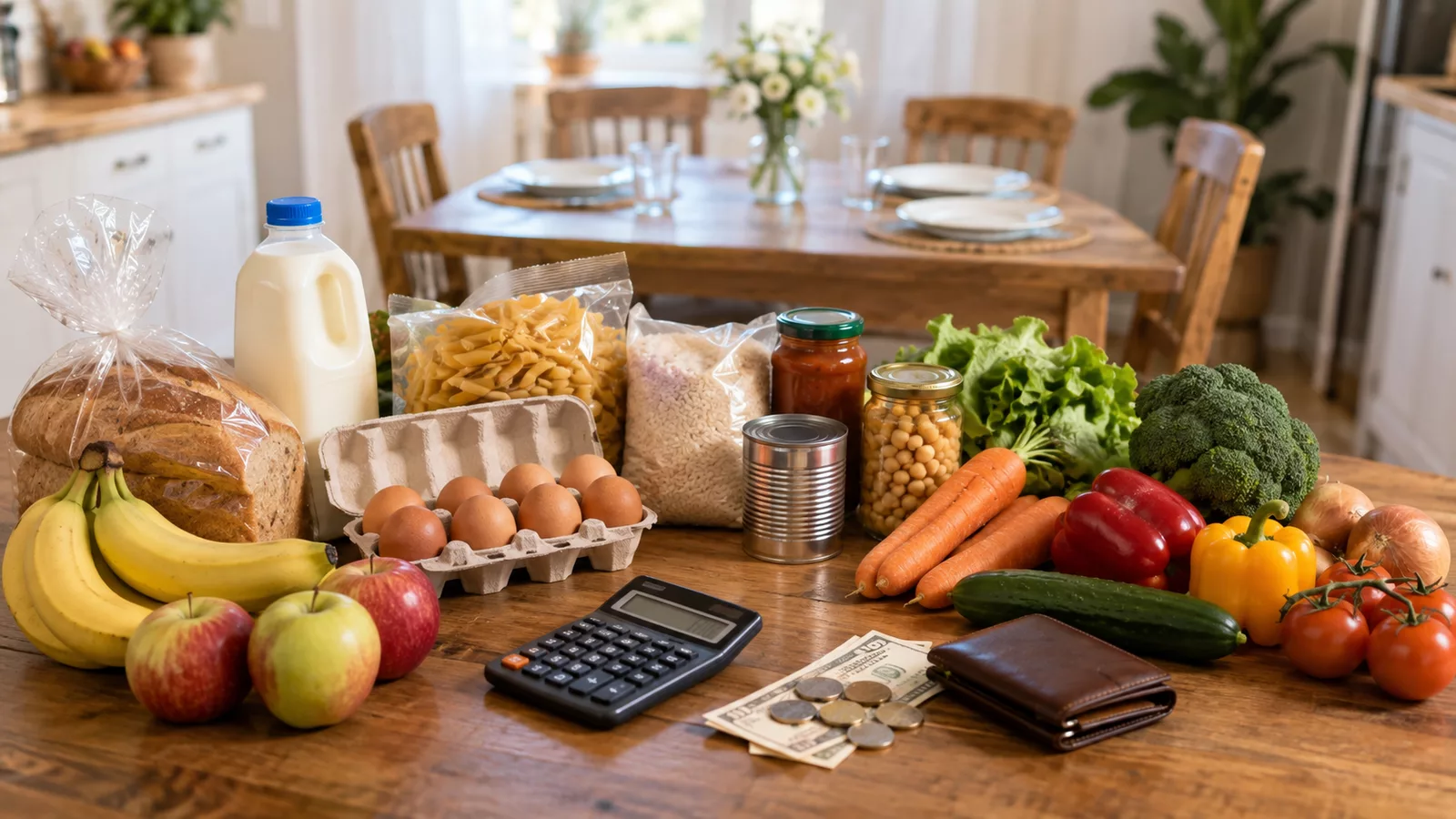
A realistic grocery budget for family of 4 in 2026 can range from about $1,025 to more than $1,680 per month using current USDA food-plan benchmarks for a reference household. For many families trying to balance cost and variety, roughly $1,100–$1,400 per month provides a more useful starting range than an arbitrary national average. But the right number depends heavily on the children’s ages, where the family lives, dietary needs, how much food is prepared at home, and what counts as a grocery purchase.
Food costs remain an important pressure on household budgets. U.S. food-at-home prices in August 2026 were 2.2% higher than a year earlier, even though prices were essentially flat from July to August. A grocery budget that worked several years ago may therefore no longer be realistic.
The solution is not simply to pick the lowest possible target. A useful grocery budget for family of 4 should cover normal meals, account for the way the household actually shops, and leave enough flexibility to prevent every unexpected grocery run from becoming a budget failure.
What Is a Realistic Grocery Budget for a Family of 4 in 2026?
For a reference U.S. family of four, about $1,025–$1,683 per month covers the range from a highly cost-conscious USDA plan to a much more flexible food plan. The Low-Cost and Moderate-Cost levels sit in the middle at approximately $1,128 and $1,391 per month.
These figures use the USDA reference household of one male and one female aged 20–50, one child aged 6–8, and one child aged 9–11. They should be treated as benchmarks rather than universal spending limits because changing the ages of the children alone can noticeably change the cost.
| Budget level | Approx. monthly cost | Approx. weekly cost | What it means in practice |
|---|---|---|---|
| Thrifty | $1,024.90 | $236.50 | Tight planning, careful food choices and meals prepared at home |
| Low-Cost | $1,127.90 | $260.30 | Cost-conscious shopping with somewhat more flexibility |
| Moderate-Cost | $1,391.10 | $321.00 | More variety and flexibility while still primarily eating at home |
| Liberal | $1,682.90 | $388.40 | Greater choice, variety and room for higher-cost foods |
For practical household budgeting, $1,100–$1,400 per month is a reasonable starting benchmark for many families of four, but it should never be treated as a rule. A family with two toddlers could spend substantially less, while a household with two teenagers may need considerably more.
Why There Is No Single Average Grocery Budget for a Family of 4
There is no universal grocery budget for family of 4 because four people can represent very different households. Two adults with a 3-year-old and 5-year-old do not have the same food requirements as two adults with two teenagers.
USDA’s July 2026 Moderate-Cost Plan illustrates the difference clearly. A child aged 4–5 is estimated at about $221.90 per month, while a male aged 14–19 is estimated at about $403.70. Replacing a young child with a teenage boy changes the monthly benchmark by more than $180 without changing the number of people in the household.
Location, shopping habits, food preferences, allergies and time available for cooking can widen the difference further. A household relying heavily on convenience foods will generally have a different cost structure from one cooking staples from scratch.
That is why a good family grocery budget starts with the household itself, not with a single number found online.
Grocery Budget for Family of 4 Per Week
A weekly grocery budget for family of 4 can start at roughly $235–$260 for a very cost-conscious household, while a more flexible target may be around $300–$325 per week. Families buying a wider range of premium, convenience or specialty foods may move toward $390 per week or more.
Weekly limits are often easier to manage than one large monthly number. A $1,300 monthly grocery budget can feel abstract at the supermarket, while a target of roughly $300 per week gives the shopper an immediate spending boundary.
A simple conversion is:
Monthly grocery budget ÷ 4.33 = average weekly grocery budget
For example, a $1,200 monthly budget becomes approximately $277 per week. A $1,400 monthly budget becomes about $323 per week.
Do not simply divide the monthly amount by four. An average month contains about 4.33 weeks, so dividing by four can quietly create an annual overspend.
Grocery Budget for Family of 4 for a Month Example
A $1,200 monthly grocery budget for family of 4 works out to roughly $277 per week. Instead of treating the entire amount as one pool of money, divide it among food categories and keep a small buffer for price changes and forgotten items.
The following example is not a prescribed diet. It is a budgeting framework that can be adjusted to match a family’s eating habits.
| Grocery category | Monthly target | Share of budget |
|---|---|---|
| Meat, fish, eggs and other proteins | $300 | 25% |
| Fruit and vegetables | $240 | 20% |
| Dairy | $120 | 10% |
| Bread, rice, pasta, cereal and grains | $144 | 12% |
| Pantry staples, sauces and cooking ingredients | $120 | 10% |
| Snacks and drinks | $96 | 8% |
| Frozen and convenience foods | $72 | 6% |
| Flexible buffer | $108 | 9% |
| Total | $1,200 | 100% |
The percentages should change with the household. A vegetarian family may spend much less in the meat category and more on produce, dairy or plant-based foods. A household managing food allergies may need a larger allowance for specialty products.
The important part is the buffer. Spending every dollar of the grocery budget on planned purchases leaves no room for a sudden price increase, an extra school lunch item, or something essential that was forgotten.
How to Build Your Own Grocery Budget for a Family of 4
The most accurate grocery budget for family of 4 starts with actual household spending over the previous two or three months. A target based on real transactions is much more useful than choosing an attractive number and hoping the family can stay under it.
Start by separating genuine groceries from purchases that happen to appear on a supermarket receipt. Toilet paper, laundry detergent, cosmetics, diapers, pet food and kitchen supplies can significantly inflate a grocery-store total even though they are not food.
Then follow this process:
- Review the last three months. Add every genuine food-at-home purchase from supermarkets, warehouse clubs, farmers markets, delivery services and other grocery retailers.
- Calculate the monthly average. Divide the total by three to establish the household’s current baseline.
- Separate groceries from dining out. Restaurant meals, delivery and takeout should normally have their own budget category.
- Identify unusual purchases. A large holiday meal or bulk purchase can distort one month’s total.
- Compare the result with a current benchmark. Use the USDA range as context rather than an absolute spending rule.
- Choose a realistic reduction. If the current average is $1,500, trying to reach $800 immediately is unlikely to produce a sustainable budget.
- Convert the target to a weekly limit. This makes the monthly plan easier to control during actual shopping.
- Review the result after four to eight weeks. Adjust the budget if the original target consistently proves too high or too low.
A grocery budget should be something the family can repeatedly follow. A $1,200 plan that works every month is more useful than an $800 target that fails every week.
Grocery Budget for Family of 4 Template
A simple grocery budget for family of 4 template should show three things: the planned amount, actual spending and the difference between them. That is enough to reveal which categories repeatedly push the household over budget.
The template below can be copied into a spreadsheet, budgeting app or notes file.
| Category | Planned | Actual | Difference |
|---|---|---|---|
| Proteins | $ | $ | $ |
| Fruit | $ | $ | $ |
| Vegetables | $ | $ | $ |
| Dairy | $ | $ | $ |
| Bread and grains | $ | $ | $ |
| Pantry staples | $ | $ | $ |
| Frozen foods | $ | $ | $ |
| Snacks | $ | $ | $ |
| Drinks | $ | $ | $ |
| Specialty foods | $ | $ | $ |
| Other food | $ | $ | $ |
| Buffer | $ | $ | $ |
| Total | $ | $ | $ |
Do not create too many categories at the beginning. If maintaining the template becomes a chore, it is less likely to be used consistently. Five to ten meaningful categories are usually more actionable than tracking dozens of individual product types.
Should Household Products Be Included in a Grocery Budget?
Household products should ideally be separated from food if the goal is to understand the true grocery budget for family of 4. A $250 supermarket receipt may contain $180 of food and $70 of detergent, paper towels, toiletries and other nonfood items.
Combining everything into one category is not necessarily wrong. Some families prefer a single “groceries and household” budget because it is easier to manage. The problem appears when that combined figure is compared with food-only benchmarks.
USDA food plans describe the cost of food and beverages intended to create meals and snacks at home. They are not a benchmark for shampoo, pet food, cleaning products, diapers or toilet paper.
Consistency matters more than the category name. Decide what the grocery budget includes and use the same definition every month.
How Children’s Ages Change a Grocery Budget for Family of 4
Children’s ages can change a grocery budget for family of 4 by hundreds of dollars per month. Teenagers generally require a larger food allocation than young children, particularly during periods of rapid growth and high activity.
Current USDA Moderate-Cost figures demonstrate the scale of the difference.
| Child | Approx. monthly cost |
|---|---|
| Age 2–3 | $207.40 |
| Age 4–5 | $221.90 |
| Age 6–8 | $305.10 |
| Age 9–11 | $350.20 |
| Female age 12–13 | $322.20 |
| Female age 14–19 | $324.60 |
| Male age 12–13 | $392.50 |
| Male age 14–19 | $403.70 |
This is one reason generic family-size averages can be misleading. A grocery budget for a family of four with two preschoolers should not automatically be compared with the budget of a household feeding two teenagers.
The better approach is to use the USDA individual age and sex categories as a reference and then adjust for actual household circumstances.
How Much of Your Income Should Go to Groceries?
There is no universal percentage of income that every family should spend on groceries. Housing costs, childcare, debt, transportation, health insurance, income and local food prices differ too much for a single percentage to work across households.
Instead, groceries should be considered within the entire monthly budget. Start with net household income and essential fixed expenses, then determine how much remains for variable necessities, savings, debt repayment and discretionary spending.
For example, two households may both spend $1,200 per month feeding four people. For one household, that figure may fit comfortably alongside housing and savings goals. For another, it may leave too little money for utilities, transportation or debt payments.
Payment and transfer costs also belong in the wider financial picture. Households using online wallets or alternative money-transfer services should account for any transaction costs instead of looking only at food spending. WeaveMoney’s guide to the Perfect Money payment system explains how one such online payment service works, including its deposit, withdrawal and transfer options.
The goal is therefore not to achieve an arbitrary grocery-to-income ratio. The goal is to create a food budget that is nutritionally practical and financially sustainable within the household’s complete budget.
How to Cut a Grocery Budget for a Family of 4 Without Making Every Meal Cheap
The easiest savings usually come from reducing waste, unnecessary convenience purchases and unplanned shopping rather than simply buying less food. A household spending $1,400 per month does not need to immediately target $800 to make meaningful progress.
Before cutting individual foods, identify where the money is actually going. Receipts from four weeks of shopping often reveal patterns that are difficult to notice while standing in the supermarket.
Several strategies can make the largest difference:
- Plan meals around ingredients already at home. Check the refrigerator, freezer and pantry before creating the next shopping list.
- Choose several meals with overlapping ingredients. Buying an ingredient for one recipe and throwing the remainder away increases the real cost of that meal.
- Compare unit prices. The cheapest package is not always the cheapest option per ounce, pound or other unit.
- Use lower-cost proteins strategically. Eggs, beans, lentils and less expensive cuts of meat can reduce the most expensive part of many meals.
- Buy store brands selectively. Staples such as flour, rice, canned vegetables and basic dairy products can offer straightforward savings when the cheaper product meets the family’s needs.
- Use frozen produce when it makes sense. It can reduce spoilage and provide flexibility when fresh produce regularly goes unused.
- Limit unplanned fill-in trips. A quick visit for milk can easily become another $40 or $50 purchase.
- Keep a small convenience-food allowance. Completely eliminating easy meals can backfire if an exhausting evening ends with much more expensive takeout.
- Freeze food before it becomes waste. Bread, meat and many prepared meals can be saved for later instead of discarded.
- Track the expensive categories first. Reducing a $350 monthly protein bill by 10% matters more than obsessing over a $3 purchase.
The objective is not to choose the cheapest possible version of every product. It is to direct more of the grocery budget toward food the family will actually eat.
Meal Planning Can Lower the Grocery Bill – but Only If the Plan Is Realistic
Meal planning can reduce grocery spending when it prevents duplicate purchases, food waste and emergency takeout. An ambitious seven-day menu that nobody has time to cook can have the opposite effect.
Build the week around the household’s schedule. If Tuesday and Thursday are consistently busy, those evenings need fast meals rather than recipes requiring an hour of preparation.
A practical weekly structure might include two regular cooked dinners, two quick meals, one leftovers night, one flexible meal using freezer or pantry ingredients, and one evening where the household chooses between cooking and eating out.
The exact pattern is less important than matching the plan to real life. The best budget meal plan is the one that gets eaten rather than abandoned by Wednesday.
What a $250 Weekly Grocery Budget for a Family of 4 Might Look Like
A $250 weekly grocery budget for family of 4 is close to the current USDA Thrifty-to-Low-Cost range for its reference household. It is possible for some families, but it generally requires planning, frequent home cooking and careful control of waste.
A hypothetical $250 allocation could look like this:
| Category | Weekly amount |
|---|---|
| Proteins | $60 |
| Fruit and vegetables | $50 |
| Dairy and eggs | $30 |
| Bread, rice, pasta and grains | $30 |
| Pantry and cooking staples | $25 |
| Snacks and drinks | $20 |
| Frozen or convenience foods | $15 |
| Flexible buffer | $20 |
| Total | $250 |
This example is intentionally flexible. Local prices and household needs can make $250 relatively comfortable in one situation and unrealistic in another.
A family that regularly buys specialty allergy-friendly products, feeds older teenagers or lives in a high-cost area should not interpret missing this target as a budgeting failure.
What a $300 Weekly Grocery Budget for a Family of 4 Might Look Like
A $300 weekly grocery budget for family of 4 equals about $1,299 per average month. That places it between the current USDA Low-Cost and Moderate-Cost benchmarks for the reference family.
The extra $50 compared with a $250 plan can provide room for more variety, additional fresh produce, higher-cost proteins or convenient foods for busy days. It can also act as a buffer rather than being automatically spent every week.
A family that normally spends $350–$375 per week may find $300 a more sustainable first target than attempting to jump directly to $200.
Monthly budgeting works best when reductions are incremental enough to become habits. Cutting $50 a week saves roughly $2,600 over a full year if the lower spending level is consistently maintained.
Is $1,000 a Month Enough for a Family of 4?
A $1,000 monthly grocery budget for family of 4 is possible for some households, but it is slightly below the July 2026 USDA Thrifty Food Plan benchmark of $1,024.90 for its reference family. It should therefore be viewed as a relatively tight target rather than a universal standard.
A family with younger children, access to lower-cost stores, limited food waste and a strong home-cooking routine may be able to stay near or below $1,000. A household with teenagers, specialty dietary requirements or higher local grocery prices may find the same target unrealistic.
There is another important qualification. USDA’s food plans assume that all meals and snacks are prepared at home. Comparing a $1,000 grocery bill plus several hundred dollars of restaurant spending with a USDA food-at-home benchmark does not provide a meaningful comparison.
Track total food spending as well as groceries if the goal is to understand what feeding the household actually costs.
Can a Family of 4 Eat on $800 a Month?
An $800 grocery budget for family of 4 equals about $185 per week, which is well below the July 2026 USDA Thrifty Food Plan benchmark for its reference family. Some households may achieve it because of younger children, unusually low local prices, food assistance, home-grown food, existing pantry supplies or highly disciplined shopping, but it should not be presented as a normal target for every family.
Trying to force spending below a realistic level can create false savings. A household may reduce the supermarket bill only to increase takeout spending, make more emergency shopping trips or repeatedly exceed the target later in the month.
If the current budget is $1,300, reducing it to $1,150 through waste reduction and better planning can be a meaningful financial improvement even if an $800 target remains unrealistic.
Budgeting works best when the number reflects actual circumstances rather than an online challenge.
Grocery Budget Mistakes That Quietly Cost Families Money
The biggest grocery budgeting mistakes often happen before checkout. An unrealistic monthly limit, inconsistent categories and shopping without knowing what is already at home can undermine even a carefully written plan.
Watch for these common problems:
- Setting the budget from someone else’s household. Family size alone does not account for age, location, diet or lifestyle.
- Ignoring nonfood purchases. Cleaning products and toiletries can make food spending appear higher than it is.
- Treating dining out as unrelated. Grocery spending can fall while total food spending rises.
- Shopping without checking the kitchen first. Duplicate purchases create waste.
- Buying bulk items solely because they look cheaper. A lower unit price saves nothing if half the product is discarded.
- Making the target too restrictive. A budget that repeatedly fails is not functioning as a useful budget.
- Ignoring irregular months. Holidays, birthdays and school breaks can change food spending.
- Using the monthly budget without a weekly limit. Overspending early in the month makes the final week unnecessarily difficult.
- Cutting everything equally. Some categories have much greater savings potential than others.
- Failing to review the budget. Prices and household needs change, so the target should change with them.
The most effective grocery budget for family of 4 is not necessarily the lowest one. It is the one that reliably controls spending without requiring constant emergency adjustments.
How Payment Habits Can Affect Grocery Budgeting
Payment method does not change the price printed on a supermarket shelf, but it can affect how easy household spending is to monitor. Cash creates an obvious physical limit, while cards and digital wallets provide transaction histories that can make weekly reviews faster.
For households using mobile payments, Google Pay can provide another digital record of purchases. The important budgeting habit is not the payment technology itself but checking transactions regularly and assigning grocery purchases to the correct category.
Keeping payment methods organized makes it easier to answer a basic budgeting question at the end of every week: how much was actually spent on food?
How to Handle a Five-Week Shopping Month
A five-week shopping month should not automatically destroy a grocery budget. The problem usually comes from treating a monthly amount as exactly four weekly allowances.
There are approximately 4.33 weeks in an average month. A household with a $1,300 monthly grocery budget therefore has an average weekly allowance of about $300, not $325.
One option is to budget annually. A $1,300 monthly target equals $15,600 per year, and weekly spending can then be monitored against the annual total rather than forcing every calendar month to look identical.
Another method is to maintain a grocery buffer. Spending $285 in a $300 week leaves $15 available for a more expensive week later.
A monthly grocery budget does not need to be identical every month to remain controlled over the year.
How to Adjust Your Grocery Budget for Holidays and School Breaks
A grocery budget for family of 4 should account for predictable seasonal changes. Holidays can increase spending on larger meals and specialty ingredients, while school breaks may shift lunches and snacks from school to the home.
Instead of treating these periods as unexpected overspending, add them to the annual food plan. If December usually costs $250 more than a normal month, setting aside roughly $20–$25 per month during the rest of the year can absorb much of the difference.
Summer can create a similar issue for households with school-age children. More meals and snacks at home can raise the supermarket bill even when the family’s overall financial habits have not changed.
A useful budget anticipates recurring expenses. Predictable seasonal spending is not an emergency.
A Simple 30-Day Plan to Reset a Grocery Budget for a Family of 4
A family does not need a complicated spreadsheet to improve grocery spending. Thirty days of accurate tracking can reveal enough information to set a much better target.
Use the month as a diagnostic period rather than immediately trying to spend as little as possible:
- Week 1 – Track everything. Record every grocery, takeout, restaurant and convenience-food purchase without changing normal behavior.
- Week 2 – Find the leaks. Identify wasted food, duplicate purchases, impulse items and expensive fill-in trips.
- Week 3 – Set category targets. Focus reductions on the two or three areas with the greatest unnecessary spending.
- Week 4 – Test a weekly cap. Choose a realistic limit and see whether it works without creating extra spending elsewhere.
- End of month – Build the next budget. Use actual results rather than assumptions to set the new monthly and weekly targets.
After several months, the family’s own spending history becomes more useful than a generic average. USDA benchmarks can still provide context, but the household data shows what is genuinely sustainable.
The Best Grocery Budget for a Family of 4 Is a Range, Not a Magic Number
A grocery budget for family of 4 in 2026 should be based on household composition, local prices and actual eating habits rather than a single national average. Current USDA benchmarks put its reference family at about $1,025 per month on the Thrifty Plan, $1,128 on the Low-Cost Plan, $1,391 on the Moderate-Cost Plan and $1,683 on the Liberal Plan.
For many households, starting around $1,100–$1,400 and then adjusting from actual spending is more practical than chasing an extremely low target. Families with young children may need less. Families with teenagers, dietary restrictions or higher local costs may need more.
The biggest savings often come from eliminating waste, planning realistic meals, reducing unplanned shopping and knowing which categories consume the most money. Those changes can lower spending without turning every grocery trip into an exercise in deprivation.
A successful grocery budget is not the smallest number a family can survive on for one month. It is a number that keeps food spending predictable month after month while leaving room for the rest of the household’s financial priorities.
FAQ About a Grocery Budget for Family of 4
There is no single figure that accurately represents every family. Current July 2026 USDA benchmarks for its reference family range from about $1,025 per month on the Thrifty Plan to $1,683 on the Liberal Plan , with Low-Cost and Moderate-Cost benchmarks around $1,128 and $1,391.
$200 per week equals roughly $867 per average month, which is below the current USDA Thrifty benchmark for its reference family. Some households can make it work, particularly with younger children or unusually low food costs, but it is a tight target and should not be treated as universally realistic.
For some households, yes. $250 per week equals about $1,083 per average month, placing it around the current USDA Thrifty-to-Low-Cost range for the reference family. Household composition and local prices can move the appropriate target considerably.
A practical starting range for many U.S. families is approximately $1,100–$1,400 per month , based on current USDA Low-Cost and Moderate-Cost benchmarks. The target should then be adjusted for children's ages, location, diet and actual spending.
Current USDA benchmarks suggest roughly $236 per week at the Thrifty level, about $260 at the Low-Cost level and around $321 at the Moderate-Cost level for its reference family. These are benchmarks rather than required spending amounts.
Usually, it is clearer to track groceries and dining out separately. USDA food-plan benchmarks assume meals and snacks are prepared at home, so restaurant and takeout spending should not be included when making a direct comparison.
It can, but separating nonfood household purchases makes it easier to understand actual food spending. If household supplies remain in the same budget, do not compare the combined total directly with food-only benchmarks.
Start with meal planning, a shopping list, pantry checks, lower-cost proteins, unit-price comparisons, store brands where appropriate, frozen foods that reduce waste and fewer unplanned shopping trips. Track actual spending for at least a month before setting a major reduction target.
Review it whenever food prices, household income, family size or dietary needs change significantly. Even without a major change, checking the target every few months can keep it aligned with actual spending and current prices. southwest companion pass

Dmytro Mykhailenko is a financial expert and a prolific author specializing in articles about money and economics. With a deep understanding of financial matters, he provides readers with valuable insights into financial planning, investing, and economic trends. His informative and practical articles help readers navigate complex financial issues and make well-informed decisions.